
lørdag 4. april 2020
Growing moon
New image of the moon. This is at april 3rd. And I have used the ASI071MC Pro for this one. Two images combined. Gain 290, exposures 1000x4 ms. Processed in AS!3, wavelets in Registax.


torsdag 2. april 2020
Not april's fools
There has been a string of clear nights with the Moon this week. So I have used the opportunity to take some images of the moon. This evening (april 1st), I tried using my ASI071MC Pro. The advantage being that I could get the whole Moon inside the frame. So no mosaic. And it did come out pretty good. I used the same setup as before, except for the camera. No binning, gain 340 and exposure 4ms. No wavelets this time. Will maybe try later. The only downside, was the ginormous filesize. 32 GB for 1000 frames. Took a while to process. I did use my ASI178MM too, and will try the mosaic later. But for now, this is the image. 16 megapixels. Click on the image, then rightclick and choose View Image to see the picture in full resolution.


tirsdag 31. mars 2020
Moonlit
I haven't been too busy updating this blog with new photos. Not
because I haven't been active atking any, but processing takes too much
time. And I have been busy doing other stuff. But yesterday, I took a
mosaic image of the Moon. It was high in the sky, and at a phase where
you can see a lot of reliefs of craters and mountains. Casting shadows
across the surface. I love that way better than a full moon. When it is
full, the surface remains flat. Lifeless. But add a lot of shadows, and
it is a completely different picture. Literally.
I made a composite of images, and stitched them together with Microsoft ICE. That is, ICE wasn't quite working the way it should this time. I don't know what threw it off, but for some reason, it refused to add one of the images, so I got a gap in the image. I had to add that in Gimp afterwards.
Tech data : William Optics 98FLT with 4x Televue Powermate. ASI178MC 2x2 binning. 1000 exposures of 4ms per image. 13 images in total. SharpCap for recording. AS!3 for stacking. Microsoft ICE for stiching. Registax for wavelets and Gimp for touchups. To view the full version, (4500 pixels tall) click on the image, then rightclick on the image and choose View Image. Then you can zoom in to see it all.

In addition, not far from the Moon, Venus was lighting up the skies. And I slewed the telescope to the planet. Using a ASI178MM (monochrome), no binning and 0.2mS exposures. 5000 of them. AS!3 picked 20% of the best, and I did a little wavelet sharpening. This was the result :

I made a composite of images, and stitched them together with Microsoft ICE. That is, ICE wasn't quite working the way it should this time. I don't know what threw it off, but for some reason, it refused to add one of the images, so I got a gap in the image. I had to add that in Gimp afterwards.
Tech data : William Optics 98FLT with 4x Televue Powermate. ASI178MC 2x2 binning. 1000 exposures of 4ms per image. 13 images in total. SharpCap for recording. AS!3 for stacking. Microsoft ICE for stiching. Registax for wavelets and Gimp for touchups. To view the full version, (4500 pixels tall) click on the image, then rightclick on the image and choose View Image. Then you can zoom in to see it all.

In addition, not far from the Moon, Venus was lighting up the skies. And I slewed the telescope to the planet. Using a ASI178MM (monochrome), no binning and 0.2mS exposures. 5000 of them. AS!3 picked 20% of the best, and I did a little wavelet sharpening. This was the result :
tirsdag 23. juli 2019
Total eclipse La Silla Observatory July 2nd 2019
I used an 8 bit cmos camera (the camera itself is 14 bit, but I only used 8...) this time to take photos of the eclipse. It was obvious when I was processing that I had limted range of values to work with. But after a few attempts, I managed to get this. Not my best image of an eclipse, but ok. I will attempt more later. Click on image for full size.
Tach details : ASI178MC camera, gain 100, exposures from 0.5ms to 2s. SkyWatcher Evoguide 50ED telescope on a SkyWatcher StarAdventurer. FireCapture for capture, Gimp 2.10 for processing.

Tach details : ASI178MC camera, gain 100, exposures from 0.5ms to 2s. SkyWatcher Evoguide 50ED telescope on a SkyWatcher StarAdventurer. FireCapture for capture, Gimp 2.10 for processing.

lørdag 22. juni 2019
Images from Namibia with short exposures.
 |
| 47 Tucana. A beautiful globular cluster. |
 |
| Centaurus A galaxy with its characteristic dust band. |
 |
| Central parts of the Eta Carina nebula. |
 |
| Omega nebula |
 |
| Trifid nebula |
 |
| Omega Centaurus, the king of globular clusters. |
søndag 29. juli 2018
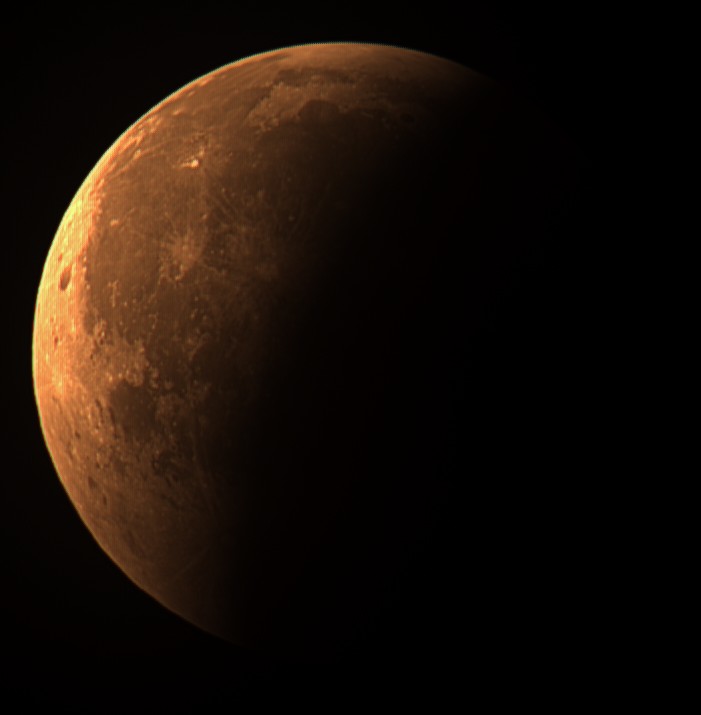
Lunar eclipse July 27th 2018
As usual, we had great weather for weeks, but the night of the lunar eclipse, there were clouds and haze on the horizon, so we saw nothing of the totality, but got to see the moon after totality. I was trying to take longer exposures to get the redness of the rest of the Moon, but due to the haze, the overexposed parts glowed over the red parts, so I had to give it up. I did take some photos before the clouds rolled in and obscured the Moon again.
I used a Williams Optics Star71 with a ZWO ASI178MC at different setting from first to last to get the colors and the exposure almost the same for the different images. Exposure from 5-10 ms and gain from 0 to 175. Firecapture for capturing, and AS!3 for stacking.


I used a Williams Optics Star71 with a ZWO ASI178MC at different setting from first to last to get the colors and the exposure almost the same for the different images. Exposure from 5-10 ms and gain from 0 to 175. Firecapture for capturing, and AS!3 for stacking.




lørdag 23. juni 2018
The Sun on June 23d.
It has been a while since the last time I posted a solar image here, so I thought it was about time. Especially since there were a few nice sunspots out this day. For the images white light images, I used an ASI178MM camera, attatched to a Williams Optics FLT98 telescope through a Lacerta Herschel Wedge. The exposure was 0.5 ms. For the closeups, I used a Televue Powermate 2.5. Processed with AS!3, Gimp and Irfanview. For the H-alpha image, I used a Lunt LS35 telescope with the same camera. Some dust probably on the blocking filter, so it needs to be cleaned... Click on the images for higher resolution.


 |
| The Sun itself with two groups of sunspots |
 | |
| The groups, close up using Televuew Powermate 2.5 |
Abonner på:
Innlegg (Atom)